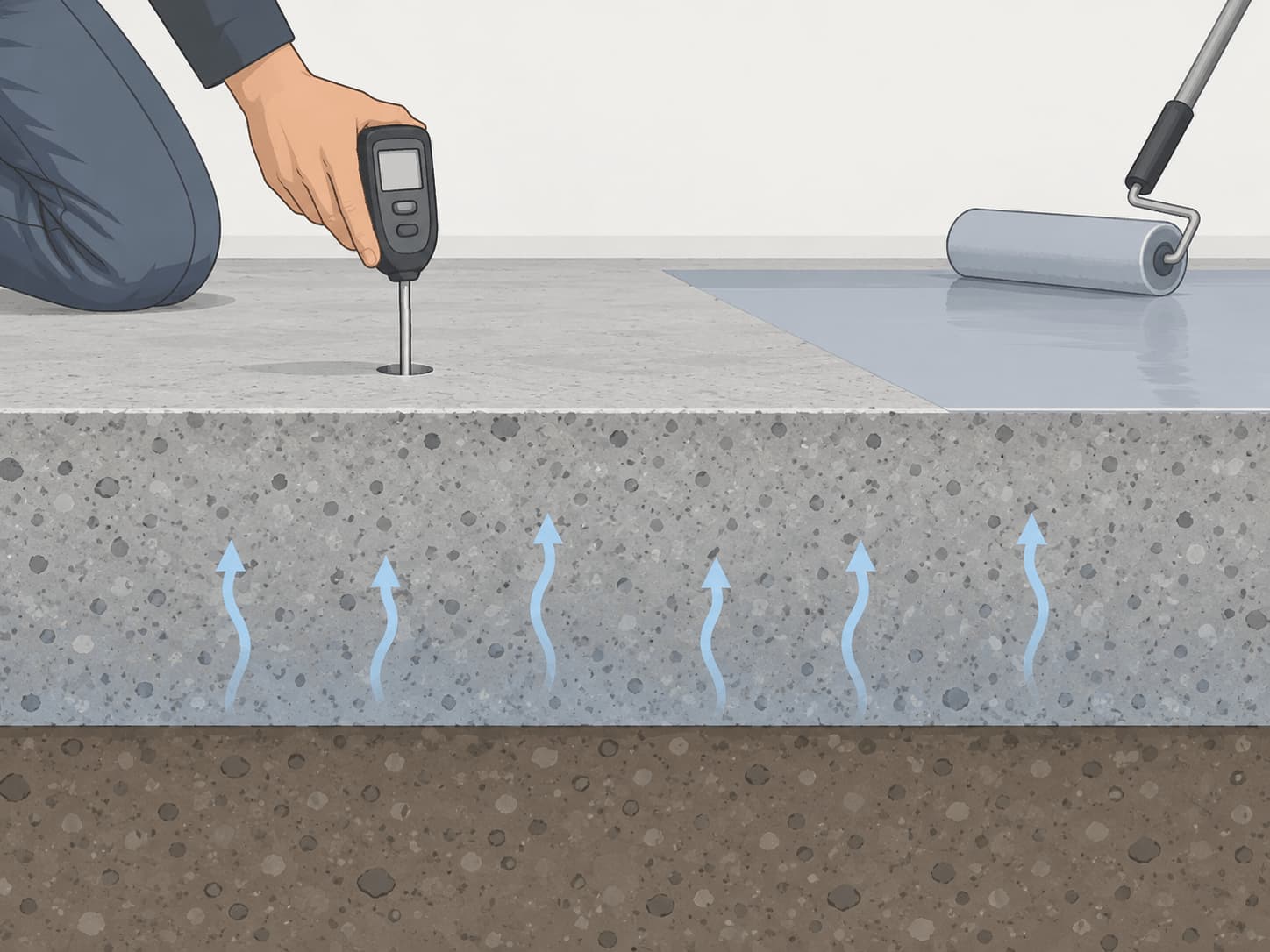
A concrete floor can look completely dry long before it is ready for an epoxy, polyurethane, sealer or other surface coating. This is one of the most common reasons coatings fail after installation. Moisture remaining inside the slab may move toward the surface, become trapped under the coating and create blisters, loss of adhesion, dark patches or peeling. For this reason, checking concrete before coating should be treated as a separate stage of the job rather than as a quick visual inspection.
Fresh concrete contains a considerable amount of water. Some of that water is needed for cement hydration, while the rest gradually leaves the slab as it dries. The surface usually loses moisture first, which can create the impression that the entire slab is dry. Deeper sections may still contain much more moisture. The thicker the slab and the less ventilation available, the longer this difference between surface and internal conditions can remain.
Drying time is influenced by much more than the age of the concrete. Temperature, relative humidity, slab thickness, ventilation, mix design and curing method can all affect the rate at which moisture leaves the material. A floor in a warm, well-ventilated building may dry very differently from a similar slab in a cool enclosed space. This is why rules based only on waiting a fixed number of days are unreliable.
Moisture and coating adhesion
Most coatings need a stable, properly prepared surface to bond correctly. Excess moisture can interfere with this bond in several ways. If water vapour moves through the slab after the coating is installed, pressure can build beneath an impermeable layer. The coating may begin to bubble or detach from the concrete.
Some systems are also sensitive to changes in the chemical environment of the surface. Moisture moving through concrete can transport alkaline compounds toward the coating interface. Depending on the product, this may weaken the adhesive bond or affect the coating itself.
The risk becomes greater with dense coatings because they allow very little moisture to escape once installed. A breathable sealer and a thick epoxy floor system do not behave in the same way. The allowable moisture condition therefore depends partly on the coating selected. The manufacturer’s installation requirements should always be checked before work begins.
Surface appearance is not enough
Concrete colour can provide clues about drying, but it should not be used as the final test. A uniform light-grey surface may still cover a damp interior. Similarly, a darker area does not always mean that the concrete contains excessive moisture. Differences in finishing, curing or aggregate can also change appearance.
Touch is even less reliable. A floor that feels dry tells very little about moisture deeper inside the slab. The important question is not simply whether there is visible water at the surface, but how much moisture remains within the concrete and whether it can migrate upward after the coating has been applied.
This is especially important where a slab is placed directly on the ground. Moisture may come not only from the original concrete mix but also from below. If the vapour barrier beneath the slab is missing, damaged or poorly installed, moisture can continue entering the concrete long after the original construction water has dried.
Methods used to check moisture
Several methods can be used to assess concrete moisture. Simple surface moisture meters can be useful for comparison and for locating areas that may require further investigation. They are fast and non-destructive, but they generally do not provide a complete picture of moisture deeper inside the slab.
A more detailed approach is in-situ relative humidity testing. Small holes are drilled into the concrete and sensors are placed at a specified depth. The measurement gives an indication of the humidity conditions within the slab rather than only at the surface. This can be particularly useful because internal moisture may later move toward the top once an impermeable coating is installed.
Another method measures moisture vapour emission from the slab surface. Different test systems are used in different markets, and coating manufacturers may specify a preferred method and maximum result. The key point is that test results should be compared with the requirements of the exact coating product rather than with a single universal moisture figure.
Testing should also be carried out in more than one location on larger floors. Concrete does not always dry uniformly. Areas near external walls, construction joints, plumbing penetrations or poorly ventilated corners may remain wetter than the centre of the slab.
Conditions before testing matter
A moisture test only represents the conditions present when it is performed. If a building has been open to weather and the test is completed before normal heating, cooling or ventilation begins, the slab may behave differently once the building is occupied.
Where possible, the space should be close to its expected service conditions before final moisture testing. Temperature and humidity inside the building influence the balance between moisture in the concrete and moisture in the surrounding air.
Construction activities can also change conditions. Wet cleaning, rain entering through open walls, new plaster or other water-intensive work may increase humidity around the slab. Testing immediately after these events can produce results that are difficult to interpret.
Preparing the slab correctly
Passing a moisture test does not mean the floor is automatically ready for coating. Surface preparation is a separate requirement. Concrete may contain curing compounds, sealers, oil, dirt, laitance or weak surface material that prevents good adhesion.
Mechanical preparation such as grinding or shot blasting is commonly used for many coating systems because it removes weak material and creates a surface profile to which the coating can bond. The required profile depends on the coating thickness and type.
Preparation can also reveal hidden defects. Small cracks, hollow areas or contamination may become more obvious after grinding. These should be addressed before the coating is installed. Applying a high-quality coating over poorly prepared concrete rarely produces a durable result.
It is also useful to remember that aggressive surface preparation does not solve a moisture problem. Grinding may make the surface look dry and clean, but it does not remove moisture stored deeper in the slab.
What to do when the slab is still too wet
If testing shows that moisture is above the acceptable level, the safest option may simply be to allow more drying time. Increasing ventilation and controlling temperature and indoor humidity can improve drying conditions, although the process may still take considerable time in a thick slab.
Where project schedules do not allow additional waiting, specialised moisture-control primers or mitigation systems may be available. These products are designed to tolerate or block higher moisture levels before the final floor coating is installed. They should not be treated as a universal shortcut. Their suitability depends on the slab, moisture source and final coating system.
If moisture is entering continuously from the ground because there is no effective vapour barrier, the problem is different from normal construction drying. In this case, installing an ordinary coating without addressing the ongoing moisture source may only postpone failure.
A measurement is more useful than a waiting period
One of the most common mistakes is assuming that concrete must be ready because a certain number of weeks have passed. Age alone cannot confirm moisture condition. Two slabs poured on the same day can reach very different moisture levels because of differences in thickness, weather and building conditions.
A better approach is to combine time with measurement. Allow the slab to dry under suitable conditions, test it using a method appropriate for the project, compare the result with the coating manufacturer’s limits and then prepare the surface correctly.
Controlling concrete drying before coating is therefore less about estimating when the floor should be ready and more about confirming when it actually is ready. That distinction can prevent expensive failures after the coating has already been installed. A few moisture readings and proper preparation usually cost far less than removing a failed floor system and applying it again.