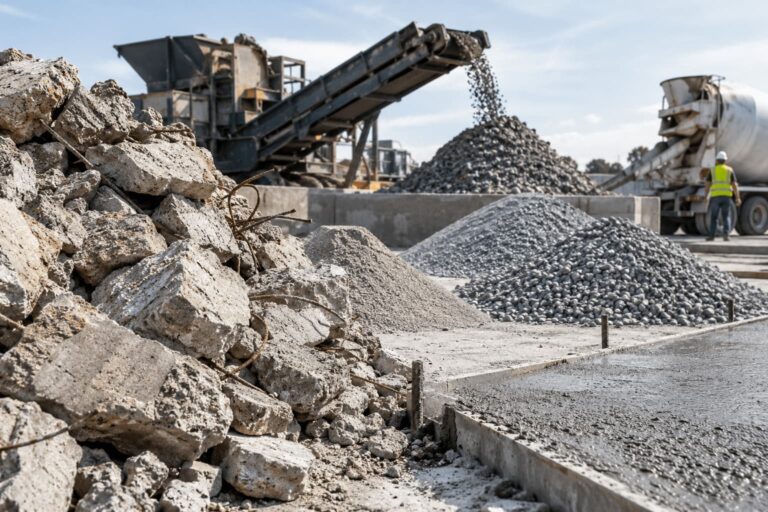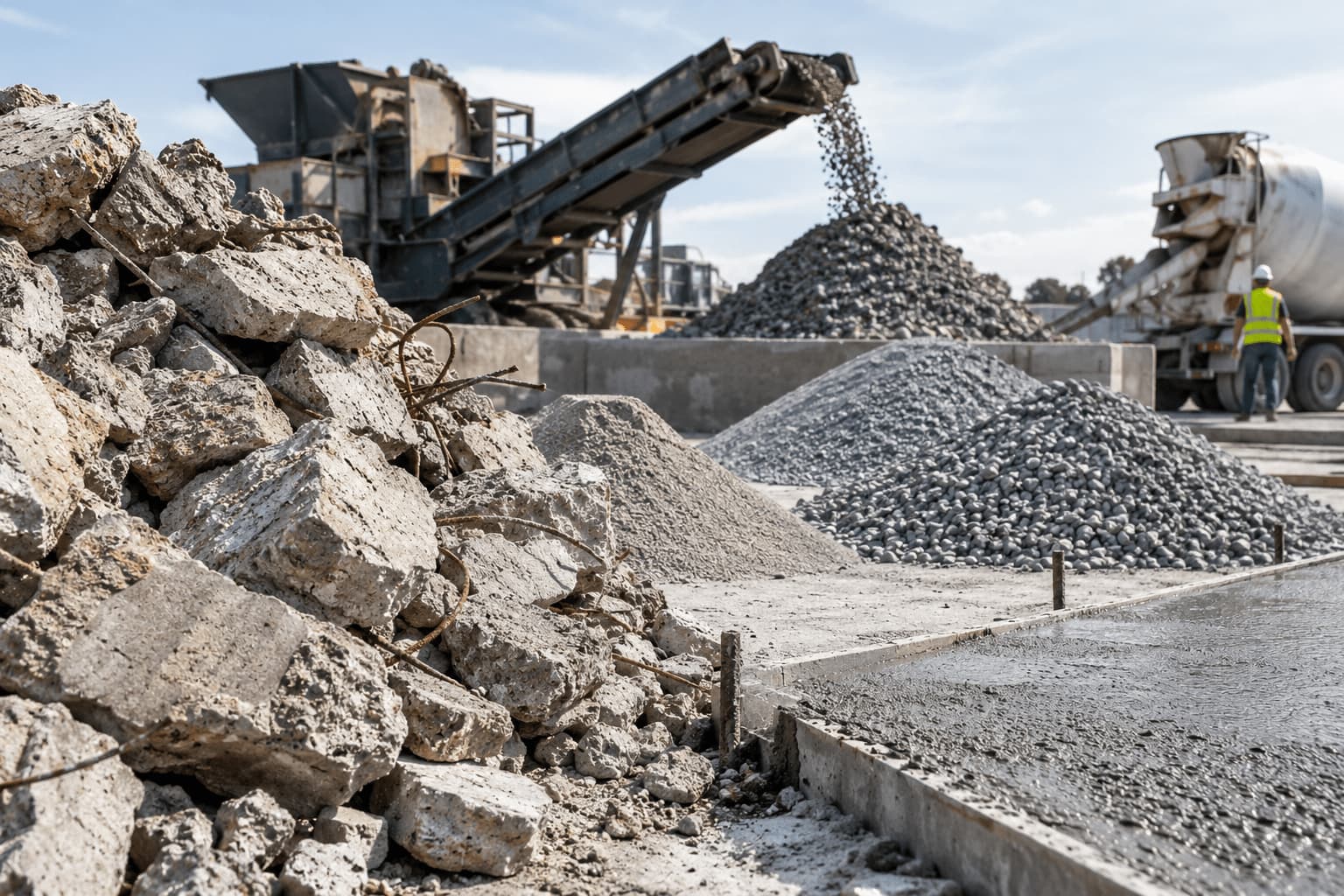
A demolished concrete slab does not automatically become useless material. On many construction sites, the first decision is whether the broken concrete should be hauled away, used as fill, processed for road base or prepared for a more demanding second life. One of the most interesting options is to return part of it to concrete production as aggregate. This can work well, but only when the material is treated as a new raw material with its own limits rather than as a cheaper version of ordinary crushed stone.
Two piles of crushed concrete can look almost identical and still behave very differently in a mixer. One may come from a strong precast element made under controlled conditions. Another may contain pieces from an old driveway, a retaining wall and a demolished floor, all produced with different mixes and exposed to different conditions. That history matters. The original concrete determines how much old mortar remains on the particles, how porous the material is and whether unwanted substances may be present. For this reason, knowing where the crushed concrete came from can be as important as knowing its particle size.
The old mortar attached to each fragment is what makes recycled concrete unusual. A natural aggregate particle is mostly solid stone. A recycled particle is often stone partly wrapped in hardened cement paste. That outer layer contains pores and small cracks created during the original service life and again during crushing. As a result, it tends to take up more water than conventional aggregate. This is not simply a laboratory detail. It changes what happens during batching. Dry recycled particles may pull water away from the fresh cement paste, while wet particles can contribute extra moisture that was not accounted for in the original mix.
This is where poor practice can create problems very quickly. If a batch feels too stiff, the easiest response on site is often to add more water. With recycled aggregate, that can hide the real cause of the problem. The mix may become easier to place, but the extra water can alter strength, drying behaviour and surface quality. A better approach is to understand the moisture condition of the recycled material before batching begins. Depending on the process, the aggregate may be conditioned beforehand, or the water in the mix may be adjusted to match its actual absorption.
The physical shape of the crushed material also affects the job. Recycled particles are often sharp, uneven and coated with rough mortar. They do not slide past one another as easily as some natural gravels. This can make the concrete feel less fluid, even when the measured slump appears acceptable. The effect becomes more noticeable when concrete must pass through a pump line, flow between closely spaced reinforcement or be finished across a large slab. Good screening and sensible grading therefore matter. A recycled product with a controlled range of particle sizes is much easier to design around than material containing excessive dust, weak fragments and random oversized pieces.
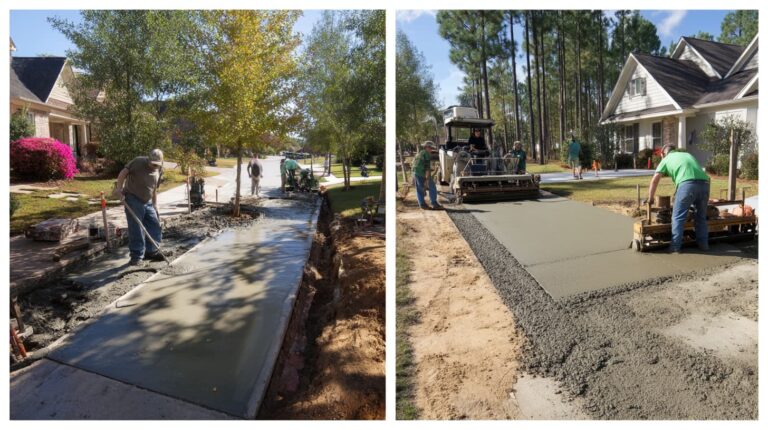
The question is not whether recycled aggregate can be used, but where it makes sense to use it. A lightly loaded external slab, a non-critical footing and a structural element exposed to aggressive conditions do not require the same level of performance. In many cases, replacing only part of the virgin aggregate is the most practical starting point. This allows the concrete producer to gain some benefit from recycled material while retaining the predictable behaviour of conventional stone. Higher recycled contents may also be possible, but they demand more confidence in the source material and more testing.
Testing becomes especially important when the concrete has a structural role. The recycled aggregate may need to be checked for grading, absorption, density and contamination. Trial batches can then show how the material affects fresh concrete and hardened performance. This is often more useful than relying on a fixed replacement percentage taken from another project. One recycled aggregate source may perform well at a certain proportion, while another may require a lower content because it contains more attached mortar or absorbs substantially more water.
There is also a timing issue that is easy to overlook. A mix containing recycled aggregate may behave differently during the period between batching and placement. If the particles continue absorbing water, workability can change faster than expected. This matters on sites where trucks face delays or where concrete needs to remain workable for longer pumping distances. A mix that looks suitable at the plant may feel quite different thirty or forty minutes later. Watching that change during trial batches can reveal problems before they appear during a large pour.
Durability should be judged according to exposure rather than assumed from compressive strength alone. A mix can achieve its required strength and still behave differently when subjected to moisture movement or repeated environmental stress. The porous mortar attached to recycled particles can influence shrinkage and permeability, particularly when the recycled fraction is high. This does not make the material unsuitable, but it means the application should be chosen carefully. Internal concrete in a protected environment presents a different risk profile from a permanently wet element or concrete exposed to salts.
The strongest case for reuse often appears when demolition and new construction take place on the same project. Instead of paying to remove large volumes of concrete and then bringing in the same volume of quarried aggregate, part of the material can potentially remain within the local construction cycle. Transport distances can be reduced and disposal requirements become smaller. However, this advantage depends on practical logistics. If the concrete must travel a long distance to be processed and then return to the project, some of the benefit can disappear.
It is also unnecessary to treat all crushed concrete as one product. Better-quality fractions may be reserved for concrete production, while more variable material can still be useful below pavements, in drainage layers or as engineered fill. This gives the demolition material several possible destinations instead of forcing everything into one use. In practice, that can be a more efficient form of recycling because the quality of each fraction is matched to the demands of the application.
The decision to use crushed concrete in a fresh mix should therefore start with questions about the material, not with a target recycling percentage. Where did it come from? How clean is it? How much water does it absorb? Is its grading consistent? What will the new concrete be expected to do? Once these questions are answered, the recycled aggregate can be incorporated deliberately rather than experimentally.
Old concrete can become useful concrete again, but the transition is not automatic. Crushing creates the opportunity; quality control makes the opportunity practical. When the source is understood, the aggregate is processed consistently and the mix is adjusted to suit its behaviour, crushed concrete can become a useful ingredient rather than simply another material leaving the site as waste.